


Identity, Otherness, and Citizenship in Arab Textbooks: How Schoolbooks Shape Tomorrow’s Citizens
15 February 2026 —
Across the Arab world, school textbooks quietly shape how young people see themselves, their communities, and the wider world. They don’t just transmit knowledge — they help define identity, belonging, and citizenship.
What Do Textbooks Really Teach? A Fresh Look at Arab Classrooms
Across the Arab world, school textbooks quietly shape how young people see themselves, their communities, and the wider world. They don’t just transmit knowledge — they help define identity, belonging, and citizenship. Recent research shows a mixed landscape. Some textbooks encourage respect, responsibility, and civic participation. Others rely on narrow nationalist or sectarian narratives that can limit students’ understanding of what citizenship truly means (Akar & Ghosn‑Chelala, 2015; Al‑Rub, 2021; Al‑Qatawneh et al., 2019).
Citizenship is often framed through loyalty to the nation‑state or adherence to specific religious or cultural norms, which can leave certain groups feeling marginalized. Yet textbooks also hold enormous potential to promote more inclusive, open‑minded visions of citizenship (Aly, 2017; Kuraedah, 2022; Maye‑Saidi, 2018). To understand this evolution, it helps to look at both the past and the present.
A Historical Lens: The United Arab Republic and the Politics of Identity
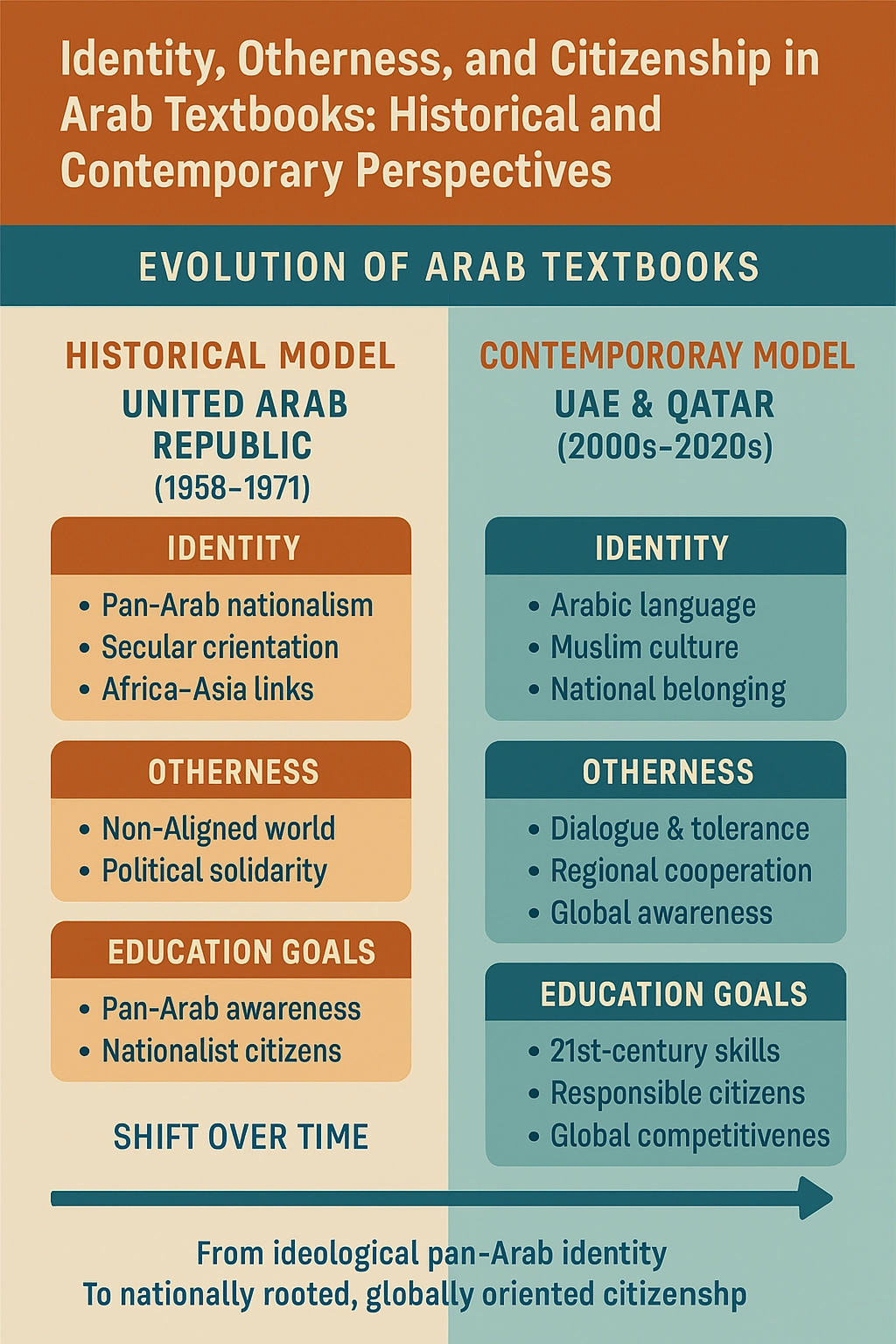
The BIE collection offers a fascinating archive of textbooks from the United Arab Republic (UAR), the political union between Egypt and Syria from 1958 to 1971. These materials reveal a curriculum deeply rooted in pan‑Arab nationalism.
Textbooks from this era emphasized:
- a unified Arab identity
- solidarity with Africa and Asia
- a secular, nationalist worldview aligned with the Non‑Aligned Movement
Notably, religion and sectarian identities were largely absent from the texbooks. The goal was to cultivate citizens who saw themselves as part of a broad Arab project rather than members of distinct religious or ethnic communities.
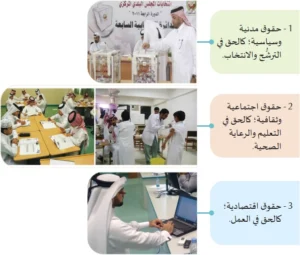
Illustration of Human rights from Qatar textbook.
This historical model contrasts sharply with today’s more diversified approaches.
Contemporary Classrooms: What UAE and Qatar Teach Today
Our recent analysis of six textbooks from the UAE and Qatar — two countries that have made significant progress in basic education, as reflected in PISA 2022 results (OECD, 2023) — shows how identity, otherness, and citizenship are framed in more multidimensional ways.
1. National Identity: Built on Three Pillars
Modern textbooks in Arab Gulf States define national identity through:
- Arabic Language A cultural anchor linked to creativity, problem‑solving, and social contribution (T1‑UAE; T5‑Q).
- Muslim Religion Integrated into ethical and cultural education, promoting solidarity and social cohesion (T1‑UAE).
- National Belonging Encouraging pride, responsibility, and voluntary civic participation (T2‑UAE; T4‑UAE).
This identity is complemented by openness to other cultures, emphasizing dialogue, tolerance, and intercultural understanding. The high rate of foreign residents probably drives this acceptance of otherness.
2. Critical Thinking and 21st‑Century Skills
A major shift from earlier decades is the emphasis on:
- critical thinking
- problem‑solving
- intercultural competence
These skills are presented as essential for navigating global challenges and contributing to national development (T2‑UAE; T5‑Q). Citizenship is no longer only about loyalty — it’s about adaptability and global engagement.
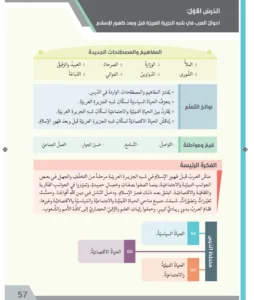
Illustration of Arabian Peninsula before and after Islam from UAE textbook.
3. How Textbooks Frame “Otherness”
Otherness is explored through both historical and global perspectives:
- Pre‑Islamic Era: recognized for positive traits such as courage and solidarity, alongside the transformative impact of Islam (T3‑UAE).
- Global Relations: the Arabian Peninsula is portrayed as a historical crossroads linking East Africa, South‑East Asia, and neighboring Gulf countries (T3‑UAE). Social studies integrate geography, history, and citizenship to situate learners within a broader global context (T6‑Q).
4. Arab Identity in a Globalized World
Today’s textbooks present identity as simultaneously: National, Arab, Muslim, Global Citizen
Students are encouraged to preserve National and Arab heritage, engage with issues facing the Muslim world, and participate in global cooperation and peacebuilding (T6‑Q). Globalization is framed as both an opportunity and a challenge — a force that must be navigated thoughtfully to protect national cultural identity (B6‑Q).
This shift reflects broader transformations across the region — from political ideology to global competitiveness, from uniformity to diversity, from inward‑looking nationalism to outward‑looking citizenship.
Why This Matters
Textbooks are more than educational tools. They are mirrors of national aspirations and blueprints for the future. Understanding how they frame identity, otherness, and citizenship helps us understand how societies imagine their next generation of citizens — and how they navigate the balance between heritage, religion, nationalism, and globalization.
References
Akar, B., & Ghosn-Chelala, M. (2015). Education for cosmopolitan citizenship in the Arab region. The SAGE handbook of research in international education, 518-539.
Al-Rub, I. O. A. (2021). The values of citizenship included in the Palestinian Arabic-language textbooks for the lower basic education. British Journal of Education, 9(2), 96-111.
Al-Qatawneh, S. S., Alsalhi, N. R., & Eltahir, M. E. (2019). The citizenship values included in intermediate stage Arabic-language textbooks and teachers’ awareness of them in the UAE: A case study. Heliyon, 5(11).
Aly, S. (2017). Citizenship education: a critical content analysis of the Egyptian citizenship education textbooks after the revolution. In Education during the Time of the Revolution in Egypt (pp. 59-79). Brill.
Kuraedah, S. (2022). The Representation of Citizenship Values in Arabic Textbooks: Marrying Delanty and Hopkins Concepts. Langkawi: Journal of The Association for Arabic and English, 161-177.
Maye-Saidi, K. (2018). Narratives and discourse on national identity in Moroccan textbooks. Multiple Alterities: Views of Others in Textbooks of the Middle East, 231-252.
OECD (2023), PISA 2022 Results (Volume I): The State of Learning and Equity in Education, PISA, OECD Publishing, Paris, https://doi.org/10.1787/53f23881-en

Abdeljalil Akkari