


The inception of world history education: IBE, UNESCO and textbooks in the Post-WWII Period
26 March 2026 —
When IBE and UNESCO began their collaboration in 1947, following the conclusion of World War II, both entities worked together in addressing topics such as the status of schooling in post-conflict societies.
IBE – UNESCO collaboration
Since its inception, 100 years ago, IBE has been collecting and facilitating research, scholarship and curriculum on a range of educational themes. When IBE and UNESCO began their collaboration in 1947, following the conclusion of World War II, both entities worked together in addressing topics such as the status of schooling in post-conflict societies. According to historical records in the IBE Documentation Centre archives, this collaboration was facilitated through the UNESCO-IBE Joint Committee. A working agreement signed in 1947 and finalized in 1951 clarified that IBE, which already had a pedagogical library including curriculum, textbooks and comparative education scholarship, would continue to collect these and to make them available to UNESCO’s Clearinghouse in the Department of Education.
The historical archives of the IBE Documentation Centre confirm that IBE continued to collect a range of textbooks and curriculum from member states, sometimes as part of the annual National Reports that member states submitted in preparation for the annual International Conference on Public Education. The IBE recorded that it received over 2000 new textbooks in 1949 alone, and by 1956 IBE had over 100,000 resources that included textbooks, children’s books, and education scholarship.
At the time, these were the only curriculum and scholarship resources available to the newly established UNESCO. The finalized agreement between IBE and UNESCO, concluded on 23 February 1951, specified in Article 1, that IBE would “furnish UNESCO the information and documentation in its possession and would comply to the fullest with any requests for study or information presented by UNESCO.”
IBE also periodically carried out research at UNESCO’s request , including on the reconstruction of schools and the financing of education, and co-organized the annual International Conference on Public Education with UNESCO. During this period, access to quality education began to be characterized as a right, with references to Article 26 of the 1948 Universal Declaration of Human Rights.
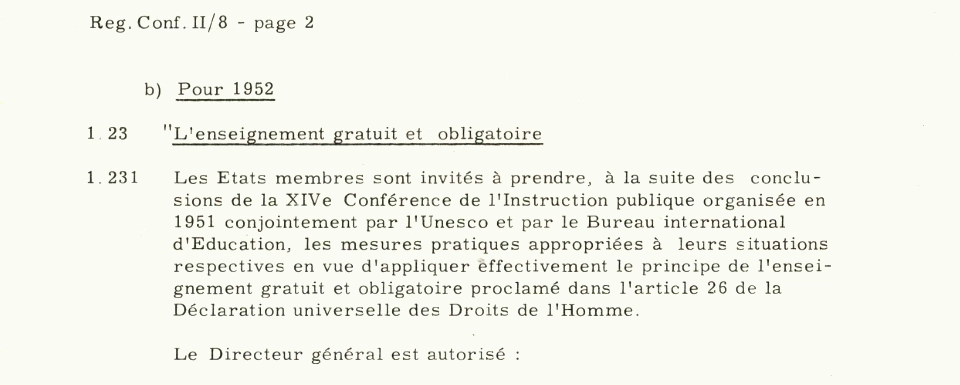
Source: UNESCO Second Regional Conference of National Commissions, 21 September 1951, Minutes, p. 2.
History Education Textbooks and IBE
It is interesting to consider whether and how IBE, in collaboration with UNESCO, was able to provide guidance to governments on national history education in the period shortly after the conclusion of the war (1947-1959). The post-WWII period was an era characterized by the reconstruction of countries that had suffered significant human and financial losses, the affirmation of democratic and human rights values, and efforts to rebuild positive relations with neighboring countries – developments that were central to the mandate of the newly established United Nations. It was also an early stage in what would be a decades-long period of decoloniality and a move away from Eurocentric approaches to education.
IBE continued to expand its existing pedagogical collection by requesting countries to share materials. From the 1950s onward, IBE’s historical archives record the procurement of history textbooks from a wide range of countries, including Belgium, France, Germany, Italy, the United Kingdon and the United States.
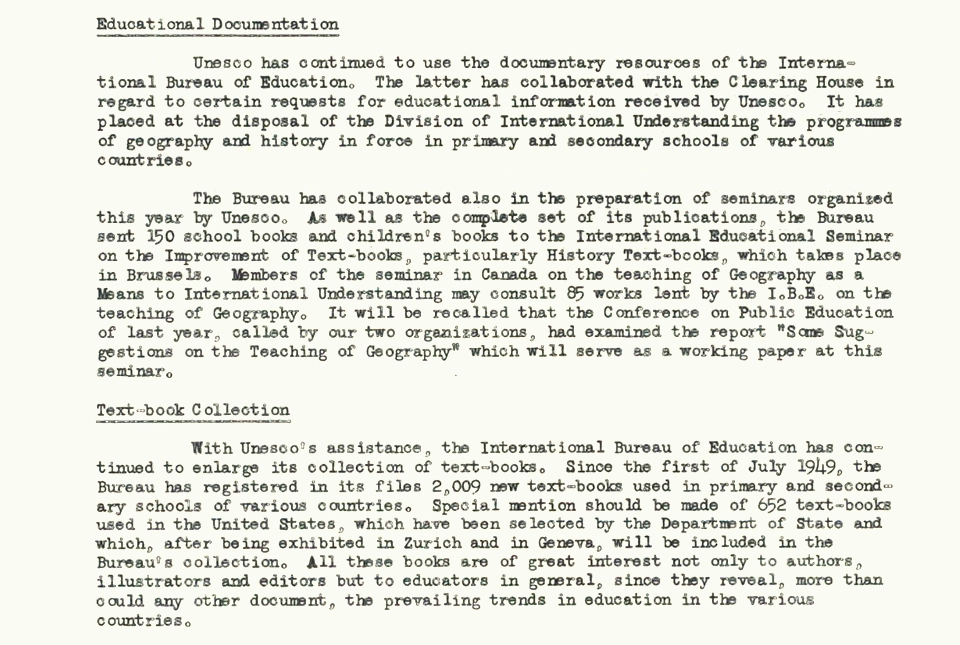
Source: Minutes of 6 July 1950 UNESCO-UBE Jt Committee Meeting, p. 3.
Records held in the IBE Documentation Centre indicate that, in the early 1950s, a focus on subject-specific matters was taken up by UNESCO. During this period, IBE carried out a study on the utilization and selection of school textbooks, in which no specific mention was made to history education. Yet the categories of “History Textbooks and International Understanding” and “Towards World Understanding” were being used to classify some of the IBE holdings by 1953.
Minutes from the 6 July 1950 UNESCO IBE Joint Committee meeting noted that IBE contributed 150 schoolbooks and children’s books – some of which concerned history education – for the International Education Seminar on the Improvement of Textbooks, held in Brussels. In the same year, IBE lent 85 geography textbooks for the seminar “Means of International Understanding”, which took place in Canada. We therefore see IBE’s pedagogical library being used explicitly to promote the agenda of world understanding.
UNESCO and History Education
Building on IBE resources and scholarship, UNESCO developed a range of efforts to promote internationalization in schools, including within history education. UNESCO held regular meetings and seminars on textbook work and on the content of history books, with a focus on addressing Eurocentric perspectives and providing sample curricula. “Classical” textbook revision in the post-WWII period involved efforts to reduce tensions and prevent future violent conflicts among states by eliminating stereotypes and enemy images from textbooks (Banerjee & Stober, 2010, p. 13).
UNESCO drew on IBE resources to begin offering guidance to member states on a multilateral and bilateral basis concerning educational materials simed at fostering coexistence and world understanding. It also offered consultative services to member states, and to bilateral and regional initiatives, to advance intergovernmental cultural agreements and research on topics of international concern (Luntinen, 1988, pp. 339-340). One example is the Major Project for Mutual Appreciation of Eastern and Western Cultural Values conducted between 1957 and 1964 (Mehlinger, 1985, p. 289). A UNESCO document from May 1957 contained a list of resources entitled “Towards World Understanding,” which referenced two history-related resources.
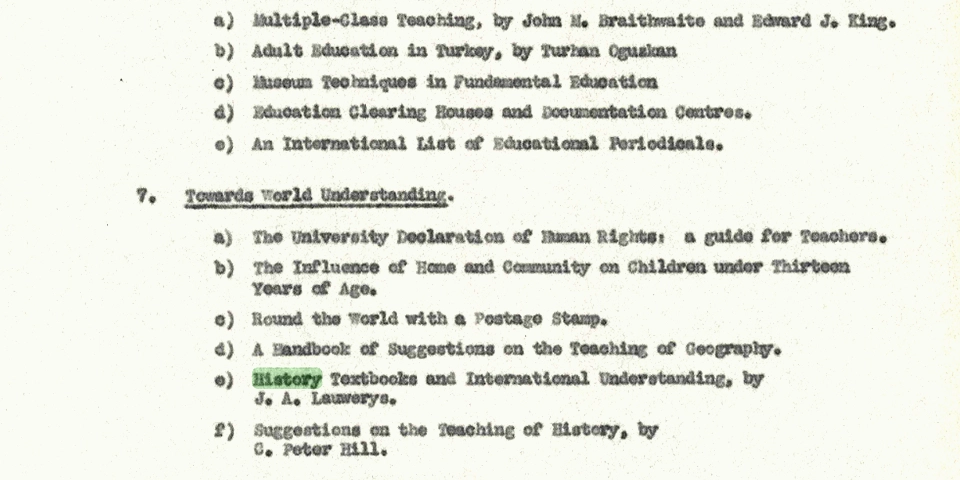
Source: May 27 1957 Recommendations from UNESCO
The history education-related resources recommended for translation were History Textbooks and International Understanding by J.A. Lauwery and Suggestions on the Teaching of History by C.P. Hill. Notably, both resources pertained to history teaching, and were published and endorsed by UNESCO, though with a disclaimer that the materials contained views of the authors and not of the organization per se.
UNESCO’s efforts to influence world history education also included the development of History of mankind: a global view of cultural and scientific development (1950), a resource intended to provide a “balanced picture of the cultural history of mankind,” although no international textbook ultimately resulted from this initiative (Luntinen, 1988, pp. 342-343). Seven years later in 1957, UNESCO began publication of the History of the Cultural and Scientific Development of Mankind, eventually comprising more than twenty volumes for use by high school and university students around the world. This initiative reflected the idea of an international history textbook, which was ultimately not accepted by member states, but nonetheless reinforced a global approach to history education (Fuchs, 2010, p. 6).
Throughout the 1950s, IBE continued to play a central role in collecting curricular materials, textbooks and comparative education scholarship that would support UNESCO’s growing efforts to promote international understanding, the right to education, and societies characterized by peace and human rights. UNESCO continued to publish practical resources, such as C.P. Hill’s Suggestions on the Teaching of History (1953), based on scholarly work and practitioner-centered consultations. This publication was based on a seminar organized by UNESCO near Paris in 1951, which brought together 70 teachers from 32 different countries to discuss the teaching of history as a means of developing international understanding. The book’s stated aim reflects UNESCO’s view at that time, and continuing into the present, that there is no single ideal or universal history syllabus. Instead there are issues that transcend national boundaries, such as trade, communication, conflict (prevention), and shared cultural values that require global understanding. History should not be comprised merely as “a succession of military triumphs or diplomatic exchanges…where the nations display their egoism and their blindness” (p. 10).
IBE and UNESCO continue to promote education that fosters global learning and disrupts exclusionary and illiberal nationalism. The early struggles and aspirations for history education reform in the post-WWII period – and the vigilance with which these organizations continue to promote peace and human rights – demonstrate both the need for, and challenges of, such efforts.
Sources
Banerjee, B.K. and Georg Stöber, G. (2010). Textbook Revision and Beyond: New Challenges for Contemporary Textbook Activities, Journal of Educational Media, Memory & Society, Vol. 2 (2). Special Issue: Contextualizing School Textbook Revision, pp. 13-28.
Fuchs, E. (2010). Introduction: Contextualizing School Textbook Revision, Journal of Educational Media, Memory & Society, Vol. 2 (2). Special Issue: Contextualizing School Textbook Revision, pp. 1-12.
Luntinen, P. (1988). School History Textbook Revision by and under the Auspices of UNESCO: Part I, Internationale Schulbuchforschung, Vol. 10 (4), pp. 337-348,
Mehlinger, H.D. (1985). International Textbook Revision: Examples from the United States Internationale Schulbuchforschung, Vol. 7 (4), pp. 287-298.

Felisa Tibbitts